Why the Prompt Book Became a Production Memory
A prompt book keeps a production’s cues, staging choices, and revisions legible, helping a company decide what to preserve, update, or leave behind.
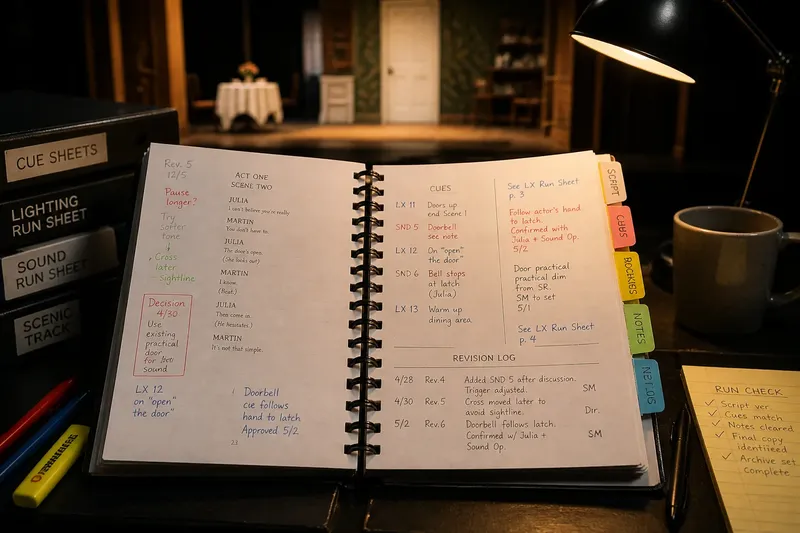
A prompt book keeps a production’s cues, staging choices, and revisions legible after the rehearsal room empties. For an amateur theatre company, it is less a vault for every scrap of paper than a working memory: a record that helps people recover the current version of the show, explain how it got there, and decide what deserves to carry forward.
Choose the record you need
The right prompt book depends on what the company needs to remember. A production with frequent cast changes needs dependable performance information; a show likely to return needs a fuller account of its choices; a short run with a settled team may need only a clear cue record and a marked script. Decide what future problem the book should solve before deciding how elaborate it should be.
Keep the production prompt book distinct from an actor’s personal notes. The actor may jot a breath, a private reminder, or a line of motivation. The production record should preserve shared decisions: where a scene begins, what triggers a sound cue, which change was approved, and whether a note still applies. That boundary keeps useful documentation from turning into a scrapbook of unverified ideas.
- If the show is still changing: use a dated working record, and make the current version easy to identify.
- If the run has settled: keep a concise operational book centered on cues, entrances, transitions, and agreed staging.
- If the production may be revived: add context that a new team could not infer from the script alone, such as why a pause or cross was chosen.
- If the company is handing the show to new operators: favor consistent cue labels and plain descriptions over shorthand only the original caller understands.
Keep cues recoverable
A cue is useful in a prompt book only if someone can locate it and understand what makes it happen. Record the cue’s identifier, the line or action that prompts it, the intended event, and any relevant coordination note. “LX 12 on ‘open the door’” is more recoverable than “lights here,” especially if the actor’s timing shifts slightly from performance to performance.
For sound, lighting, projection, and scene changes, keep the book aligned with the people who operate them. The script may show where a cue falls, while a separate console or run sheet carries technical detail. Cross-reference those records rather than copying every setting into several documents; duplicated information can quietly drift apart.
Imagine a small company whose recorded doorbell sometimes arrives before the actor reaches the door. The stage manager dates a note that the cue follows the actor’s hand touching the latch, then confirms that trigger with the performer and sound operator. The expected result is a shared, observable action to listen for, not a cue dependent on an actor’s changing pace through a line.
Separate choices from revisions
Staging notes should distinguish what the company decided from what someone merely suggested. A penciled option such as “try a longer pause” is not the same as an agreed pause that shapes a later entrance. Mark proposals clearly, then update or remove them when the director and performers settle the moment.
Use a simple revision convention: date the change, name the affected page or cue, state what changed, and identify who needs the update. If the script is reprinted, note which copy is current and carry approved changes into it. There is no need to preserve every abandoned wording or rehearsal experiment in the active prompt book; keep only a brief decision trail when the reason may matter later.
This is where the book differs from memorizing lines. Actors need to learn their text and actions, but memory alone cannot tell a replacement operator whether a cue was moved, whether a crossing was adjusted to avoid a sightline problem, or whether a note belongs to an earlier draft. The book records the agreed production language; it does not perform the play on anyone’s behalf.
What should the book preserve?
Should every rehearsal note stay?
No. Retain notes that affect the current staging, cueing, or an important decision a future team may need to understand. Remove or archive tentative ideas once they are resolved, so a reader does not mistake an experiment for the chosen version.
Does a prompt book need the whole script?
A complete, authorized working script is usually the clearest base for marking cues and page references. If the company uses a separate cue sheet, keep it easy to match to that script, and follow the script publisher’s terms for copying or sharing material.
Who should update it?
Give one person responsibility for maintaining the shared record, often the stage manager or another designated production team member. Directors, performers, and operators can flag changes, but a single editor helps prevent conflicting versions from circulating.
What belongs in an archive copy?
Keep the final marked script, cue references, a dated change record, and concise notes that explain choices not obvious from the page. Preserve enough context to make the record intelligible, while leaving private actor annotations and irrelevant paperwork out of the company archive.
Choose a format that lasts
A paper prompt book suits a production where quick page turns, handwritten marks, and a stable working copy matter most. Use clear tabs, consistent symbols, and notes written large enough to scan under work lights. Protect the master from casual edits; if a change is approved, make it legible in the master rather than relying on a loose note that may disappear.
A digital record works well when several people need access or when revisions arrive between rehearsals. Keep one clearly named master file, use comments for proposals, and move accepted changes into the main text. A shared folder can hold cue sheets and the final script, but avoid multiple files named “final” or “latest.” The format matters less than knowing which copy governs the performance.
Do not spend rehearsal time designing elaborate color codes, decorative covers, or a perfect archive structure unless they solve a real retrieval problem. A modest system that everyone understands is more useful than a beautiful book whose symbols only its maker can decode.
Leave a usable trace
Before the run closes, check that cue references still match the current script, unresolved notes are marked as unresolved or removed, and the final version is identifiable. Ask someone who did not maintain the book to locate a cue and explain the relevant staging note. If they can do so without decoding private shorthand, the record is doing its job.
A prompt book earns its place by making a production’s decisions findable, not by pretending to capture every moment in the room. Treat it as the company’s memory of what was agreed and why, and the next person who opens it can inherit a playable show rather than a pile of marks.