One Set, Several Scenes: Two Ways to Signal a Change of Place
One set, several scenes can flow with an open playing space or fixed scenic anchors; choose the approach that makes each location legible without slowing the play.
One set, several scenes can feel like distinct places if the audience gets a clear visual cue before the next line begins. For an amateur production, the choice often comes down to two approaches: leave the playing space flexible and signal each location through selective changes, or keep a few scenic anchors in place and let the action reframe them. Neither requires a parade of furniture. The useful question is what the audience must recognize, and how quickly.
Start with the audience’s map
A scene change asks spectators to revise their mental map. A table that was a kitchen counter may become a courtroom desk; a doorway may suggest a house in one scene and a shop in another. If the new location depends on a detail that can only be seen from one seat, the cue may not travel across the room.
Read each transition in the script as a small design problem. Note the new place, the first action there, and the detail that makes the place matter. A new location may need to be unmistakable, or it may only need to feel different enough for the next exchange. Those are different demands, and the set should not work harder than the scene needs.
It helps to sort locations by their visual identity. Is the distinction mainly about scale, privacy, status, or what the characters can touch? A cramped office and a public waiting area might share a wall and chairs, while a kitchen and a train platform may need more contrasting cues. The script’s action offers a better guide than a literal inventory of every place mentioned.
Keep the space open
An open playing space uses little or no fixed scenery. A change of place can come from actor entrances, a shift in the lighting, a hand prop, or a compact piece of furniture moved by performers. The room stays available for quick transformations, and the actors’ behavior becomes part of the visual punctuation.
This approach is useful when scenes move often, when the stage is shallow, or when a production has limited storage and crew. It can also preserve a strong sense of momentum: instead of waiting for a full scene change, the audience watches the next place take shape in plain view. That visibility is a design choice, not a flaw to disguise.
Open space does ask for discipline. A chair moved without purpose can look like clutter; a prop introduced without a clear cue may seem like an accident. Choose a small vocabulary of objects and give each one a recognizable job. A folding chair might mark a bus stop, while a clipboard and a change in the actors’ posture establish an office. If the same object appears in several locations, vary its placement or use so the audience can read the difference.
Lighting can sharpen the shift, but it need not perform a complicated trick. A warmer area, a tighter pool, or a deliberate change in brightness may help direct attention, provided the faces remain visible and the shift fits the equipment and operator. If lighting changes are subtle in the venue, pair them with an actor’s action or a visible prop rather than asking light alone to explain the location.
Build around fixed anchors
A few fixed scenic anchors give the stage a stable visual grammar. These might be a doorway, a low platform, a window frame, or a broad, neutral wall. Actors and small objects then define the specific scene around them. The anchor does not need to represent one literal room; it can serve as a recurring point of reference that changes meaning with the action.
Anchors can make a production feel coherent when the play returns to related places or when a central structure helps the audience understand relationships between scenes. A doorway, for instance, can suggest welcome, exclusion, or surveillance depending on who controls it. That is richer than adding a different door for every location, and it gives performers a consistent physical feature to use.
The risk is visual overcommitment. A permanent desk, staircase, or wall treatment may imply a specific room even when the scene has moved elsewhere. Keep an anchor neutral enough to support more than one reading, and reserve the clearest location cues for details that can be added, removed, or repositioned. Before building anything substantial, confirm that it fits the venue, sightlines, access needs, and the production’s available resources.
Think in layers: the anchor establishes the stage’s broad structure, while movable pieces tell the audience what this scene is. A small table placed beside a window frame may read as a home; the same frame paired with a bench and a public announcement prop may suggest a waiting area. Keep the contrast purposeful, not decorative. Each added object should clarify a relationship, action, or location.
Choose a change language
Whichever approach you choose, make the transitions speak a consistent visual language. If one scene change is marked by a chair carried on, another by a lighting shift, and a third by a large blackout, the audience may struggle to tell whether the differences are meaningful or merely logistical. A pattern gives them something to learn.
That does not mean every transition must look identical. Instead, decide what remains stable and what signals change. An open-space production might keep the same bare floor while actors move one symbolic object into view. An anchor-based production might keep the central frame fixed while changing the furniture and the actors’ relationship to it. Repetition creates continuity; variation identifies the new place.
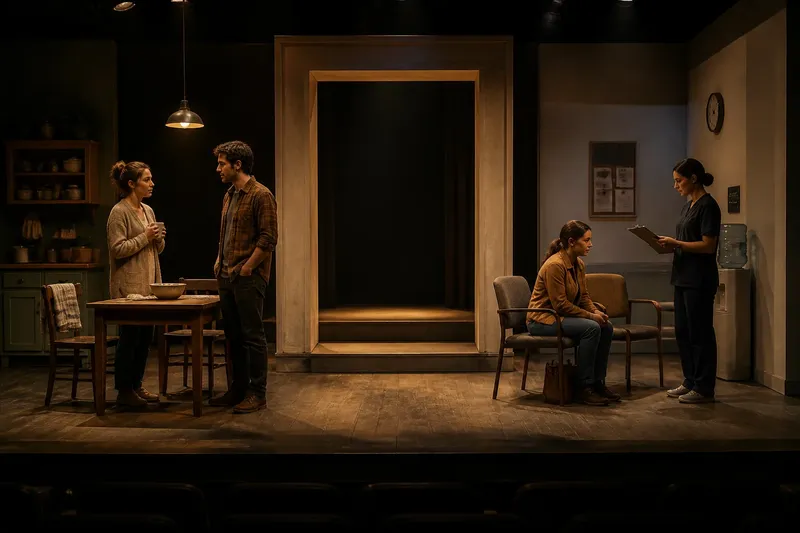
Imagine a play that alternates between a family kitchen and a clinic waiting room. The design team could use an open floor, letting a table and a bowl establish the kitchen, then clearing them as two chairs and a clipboard arrive for the clinic. Or it could retain a central rectangular frame as a neutral anchor, with the actors’ arrangement and a few carried objects distinguishing each place. In either version, the expected result is that spectators recognize the setting change before the scene’s dialogue has to explain it.
Make the cue readable
Test the change from different parts of the room, not just from the stage edge. A narrow prop may disappear behind a performer, and a furniture move may be clear from the center but confusing from a side seat. Ask a few observers who have not been told the intended location what they think the scene has become. Their responses can reveal whether the cue is visible, whether it arrives in time, and whether an extra detail is needed.
Watch the timing as well as the picture. A location cue that arrives after the actors have begun a new scene makes the opening lines do double duty. If the move itself is visible, choreograph it as part of the transition: performers can carry objects with a shared pace and place them where the next action will use them. Keep routes clear, and avoid making a quick change depend on an awkward reach or a collision-prone crossing.
Props and set pieces should remain easy to distinguish in the production’s actual light. A pale cup against a pale table may vanish, while a dark clipboard can register cleanly in a broad stage picture. Color is only one option; size, silhouette, texture, and position can make a cue legible too. Look at the scene as a whole rather than judging objects in isolation.
When a shift is intentionally ambiguous, resist explaining it with a pile of symbols. A single actor’s change of focus or a purposeful rearrangement may be enough to signal that the world has altered. Ambiguity works when it is shared with the audience, not when viewers are left unsure whether the crew missed a cue.
Which approach fits?
When does an open playing space work best?
It suits plays with frequent location changes, a small stage, or scenes that can be distinguished through action and a few portable objects. It is less persuasive when the script depends on a detailed physical environment that actors must use continuously.
When are fixed scenic anchors useful?
Anchors help when recurring places share a visual connection or when a stable structure gives actors and audiences a reliable reference. They can become restrictive if their shape strongly suggests a single location that the play rarely visits.
Can the two approaches be combined?
Yes. A production can keep one neutral frame or platform in place while using a largely open floor for scene-specific furniture and props. The combination works best when the fixed element supports several scenes rather than competing with each new arrangement.
What is not worth the effort?
It is rarely useful to build a miniature version of every location if a few clear cues can do the same dramatic work. Tiny labels, hidden decorative details, and elaborate changes that spectators cannot see add labor without improving the stage picture.
Let the scene lead
Choose the approach by looking at what actors actually do in each place. If the action depends on a specific threshold, work surface, or sightline, give that feature enough physical presence to support the performance. If the scene turns on a conversation that could happen almost anywhere, a restrained cue may leave more room for the actors and the audience’s imagination.
For one set, several scenes, the best design is not necessarily the one with the most scenery or the fastest blackout. It is the one that makes the next place understandable at the moment the play needs it. Keep the audience’s view in mind, make each cue earn its space, and let the scene’s first action complete the transformation.