The Costume Detail That Says Too Much
Choose stage costumes that clarify a character without turning every pocket, color, and accessory into a clue the audience must decode.
A stage costume works best when its strongest details point in the same direction. Costume design for amateur theatre does not need to explain a character from collar to shoes; a few deliberate signals can make the performer readable while leaving room for the play to unfold.
Start with the scene
Before pulling clothes from a rack or asking cast members to bring options, read the scene for what the audience needs to notice. Is the character trying to appear respectable, blend into a crowd, or hold onto a version of themselves that no longer fits? Choose a visible impression, not a full biography.
Write down one short costume intention for each character, such as “carefully proper” or “ready to leave.” This is a working tool for the design team, not a line the audience needs to decipher. It helps separate useful visual information from details that merely feel clever in isolation.
Choose a visual anchor
Pick one primary signal the audience can register from the seats. It might be a crisp jacket, a deliberately oversized cardigan, a tightly controlled color, or a silhouette that contrasts with the rest of the cast. The anchor should suit the character’s place in the scene and remain visible under the production’s lighting.
Then choose, at most, one supporting detail. A worn cuff could reinforce a character’s practical habits; a neat scarf could sharpen an impression of formality. If the jacket, scarf, shoes, bag, and jewelry all tell separate stories, the costume starts competing with the actor’s face and the scene’s action.
Build a restrained palette
Decide how the character’s colors sit among the other costumes before choosing individual pieces. A quiet palette can let one strong shape stand out; a vivid palette may be useful when the staging needs a clear figure in a busy group. The point is not to assign a symbolic meaning to every color, but to create a visual relationship the audience can grasp quickly.
Check fabric and color in the actual performance space, with the lighting that will be used if possible. A subtle shade may disappear against the set, while a shiny surface can catch attention at moments that do not call for it. Make the decision by looking from the audience area, not only at a fitting-room mirror.
Fit details to action
Costumes must allow performers to do the work of the scene. A character who sits, reaches, embraces, or handles a prop needs clothing that supports those actions without drawing accidental focus. A symbolic pocket is not useful if it bulges awkwardly whenever the actor turns; a dramatic sleeve is a poor choice if it repeatedly catches on a chair.
Ask performers to move through the scene in the proposed outfit. Watch for bunching, slipping, noisy fabric, and accessories that need constant adjustment. For anything involving a safety concern, follow the relevant maker instructions and venue rules, and ask a qualified professional when needed.
Keep character clues selective
Let behavior carry information that clothing does not need to announce. An actor’s posture, pace, and handling of an object may reveal more than a collection of conspicuous accessories. Costume can support those choices, but it should not turn every trait into a visual label.
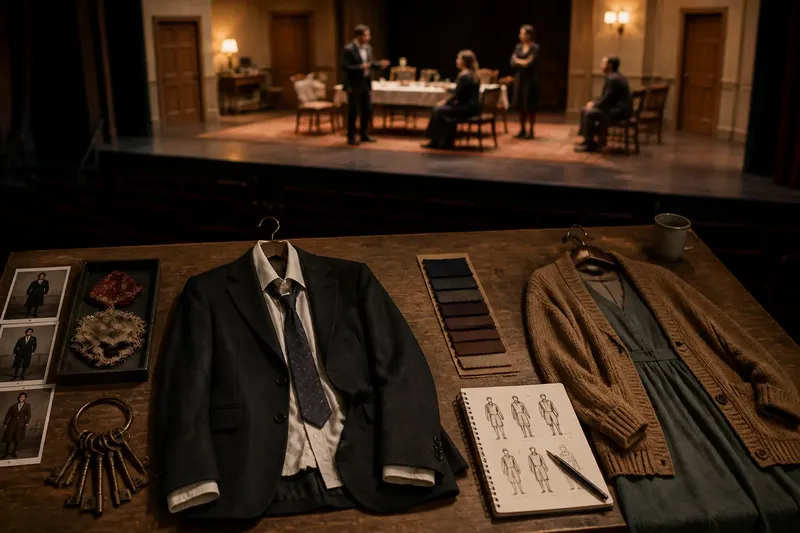
Imagine a community theatre is staging a dinner scene, and one character has recently lost control of a carefully planned evening. The designer begins with a tidy dark jacket, then considers a crooked tie, a conspicuously frayed cuff, a bright pocket square, and a large key ring. Keeping the jacket and adding just the slightly loosened tie gives the actor a clean visual starting point; the unraveling can emerge through the performance instead of arriving as a bundle of clues.
What should the audience notice?
Should every character have a signature accessory?
No. A signature accessory helps only when it supports a clear visual intention or matters to the action. Otherwise, it can make a character look like a collection of props rather than a person in the scene.
How can costumes show a change in status?
Change one established feature, such as the formality, fit, or color relationship, rather than replacing the entire visual idea. A selective shift lets the audience compare the new appearance with what they have already seen.
What if a performer brings a meaningful personal item?
Consider whether the item reads clearly from the audience and belongs in the production’s visual language. If it adds another competing clue, keep it out of the costume or reserve it for a moment when it has a specific dramatic purpose.
How many costume details are too many?
There is no fixed count, but each detail should earn its place by serving the scene, the performer’s movement, or the chosen visual anchor. If removing an item makes the costume clearer without taking away necessary information, leave it out.
Make a final edit
Lay out each complete outfit and view it from a distance, then watch the actor wear it in the scene. Ask which detail catches the eye first, whether that is the detail you intended, and whether anything else is asking for equal attention. A phone photo taken from the back of the room can help the team compare impressions without getting lost in close-up texture.
Keep the detail that strengthens the character’s visible presence, and remove the one that explains what the scene can reveal on its own. For costume design in amateur theatre, restraint is not a lack of imagination; it is a way to make the performer, rather than the accessories, the audience’s clearest point of focus.