A First Read-Through with Room to Listen
A first read-through can reveal a play’s shape before performance choices take hold, giving an amateur theatre cast shared questions to carry into rehearsal.
A first read-through works best when the cast can hear a play’s shape before anyone decides how a character should sound. For an amateur theatre company, that means treating the opening session as a listening exercise: follow the story’s turns, notice what remains unclear, and leave performance choices open.
Imagine a community theatre group gathering to read a new script about a family preparing to sell a seaside café. The director has a cast, a table, printed scripts and one evening before regular rehearsals begin. The aim is not to create a polished performance. It is to leave with a shared sense of what the play is doing and a manageable set of questions to investigate.
Set a listening agreement
Before assigning the first page, the director explains what this session is—and is not. No one needs to demonstrate a finished interpretation, invent a voice, or chase laughs. Actors can read plainly, with enough attention to punctuation and relationships to make the dialogue intelligible.
This agreement matters because an early flourish can become a quiet instruction. If an actor gives a line a comic lilt, the room may start treating the scene as a comedy even when the script leaves that possibility unsettled. A neutral first pass keeps the text audible without pretending that actors can read without choices at all.
The director also makes room for questions without turning the reading into a discussion after every page. Readers can mark a question in the margin, then continue. If a line blocks the story completely, the group can pause briefly to establish what the words say, not to settle how they should be played.
Prepare the room
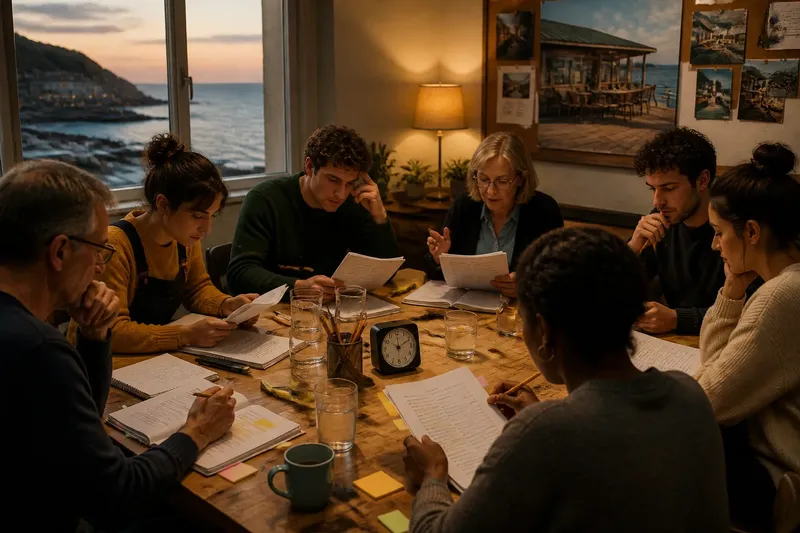
For this invented café play, the company sits around one table in script order. A reader takes the stage directions, the director keeps time and notes observations, and actors read their assigned roles. The arrangement supports a simple purpose: everyone should hear each other and follow who is speaking.
The director asks readers to use their own names before their first line only if role changes might confuse the room; otherwise, character names and clear page turns do the job. A glass of water, pencils, spare scripts and a visible clock help the session run without creating a production setup. Props, costumes, blocking and music would add activity without answering the questions this first meeting is meant to raise.
One practical choice is to ask actors not to stop and repair every stumble. A misread word can be corrected on the spot if it changes the meaning, but a stumble that does not derail the scene need not trigger a second performance. The group is listening for the play’s movement, not polishing its delivery.
Read through the turns
As the café play unfolds, the director listens for changes in the room’s understanding. The family begins with practical talk about the sale; a daughter’s arrival shifts the subject toward an old promise; a later scene reveals that different relatives believe they agreed to different terms. The point is not to label each moment with a dramatic technique. It is to hear where the audience’s attention may move.
In the first act, the actors may notice that a quiet exchange carries more tension than a louder argument. They do not need to amplify it yet. The director can note the page and the change in stakes, then let the reading continue so the scene’s place in the whole play remains audible.
When a character says, “You said we could keep it,” the room might wonder whether “it” means the café, a family object, or a promise. The director records the ambiguity rather than supplying an answer. If the next scene clarifies it, the question becomes a useful thread through the play; if not, it becomes something to examine with the script and, where appropriate, its author.
Listen, too, for stretches that seem to change speed or direction. A run of short exchanges may feel quick even at a plain reading, while a long explanation may slow the room. These are observations, not verdicts. The actors have not yet explored pauses, physical action or the pressure one person can place on another.
Mark questions, not solutions
Notes from this read-through should describe what prompted attention. “The sale becomes real here” is more useful than “make this line sad.” “I lost track of why the brother left” gives the company something to check; “the brother is evasive” turns a question into an early character judgment.
For the imagined café play, the director’s page notes might include:
- At the first mention of the sale, several characters seem to know different details. Check whether the script establishes what each person has been told.
- The daughter’s arrival changes the family’s subject quickly. Notice whether the shift reads clearly without added explanation.
- A joke earns a laugh, then the next line changes the mood. Read the surrounding exchange again later to see how the tonal turn works.
- The café’s history is described in several scenes. Track which details are new and which seem repeated.
- The ending leaves the sale unresolved. Ask whether that uncertainty feels intentional in the context of the whole play.
These notes do not form a report card for the script or the cast. They are a record of where attention sharpened, wandered or met a question. Keep them specific enough that the company can return to the relevant passage without claiming to know the answer already.
After the final page
When the reading ends, avoid asking for a verdict on the play while the final moment is still settling. Give the room a short pause, then invite observations about the story’s movement: where a person’s understanding changed, which question stayed open, and where the pace seemed to gather or loosen.
Say you are directing the invented café play and three actors independently mention the daughter’s arrival as a turning point. That is a reason to revisit the passage, not proof that it already works. In the next rehearsal, the director can ask what each character knows at that moment, read the exchange again, and observe whether the shift becomes clearer without prescribing a tone or gesture.
Separate the answers the script provides from the questions it leaves deliberately open. A character’s motive may be unclear because the text has not revealed it yet, because the actor has not encountered the clue, or because the play wants the audience to wonder. Those possibilities call for different conversations, so avoid collapsing them into one note.
It is not worth collecting a long list of favorite lines or trying to resolve every uncertainty before the first scene rehearsal. A few precise observations are easier to carry forward than a roomful of instant opinions. The useful result is a map of attention, not a set of instructions for how the play must feel.
Questions worth carrying forward?
Should actors use accents?
Only if an accent is clearly required to understand the text or is part of the agreed reading approach. Otherwise, plain speech helps the cast hear the writing before accent work begins to shape character choices.
Should the director stop the reading?
Pause when a basic textual point prevents the scene from making sense, then return to the page and continue. Save broader interpretation questions for the discussion after the full play, when their place in the story is easier to judge.
What if the cast laughs in an unexpected place?
Let the moment pass and note where it happened. The laugh may reveal a comic possibility, an unintended reading or simply the room’s response; later rehearsal can explore which explanation fits the play.
Should the company read the play twice?
A second full reading is not automatically more useful than moving into focused scene work. Consider another read if the first was interrupted often or if the company needs to hear a particular sequence again as part of the whole.
Carry the shape forward
At the next rehearsal, the director brings the café play’s notes back to the cast and chooses one question to explore: what does each family member believe has been promised? The actors return to the relevant scenes, compare those beliefs with the words on the page, and try the exchange without adding a fixed emotional result.
The first read-through has done its job if the company leaves with a clearer sense of the play’s turns and a few honest questions worth testing. A first read-through should make the text more available, not smaller. Let its unanswered details stay alive long enough for the actors and director to discover what the play can support.